I’m pleased to share that my article “Anti-Gender Fundamentalist Traditionalism and Vulnerability to Misinformation” has been accepted for publication in the Journal of Media and Religion (also see the preprint and free copies linked at the end of this post). This paper is part of a broader research program I’ve been developing over the past few years on digital traditionalism—a field of inquiry that explores how traditionalist value systems take shape, circulate, and gain influence in digital environments.
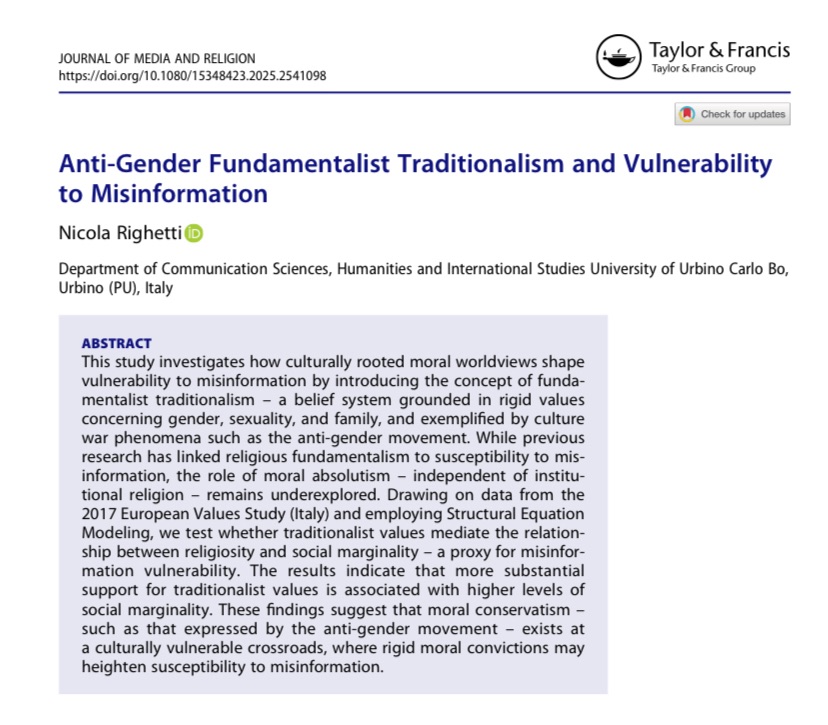
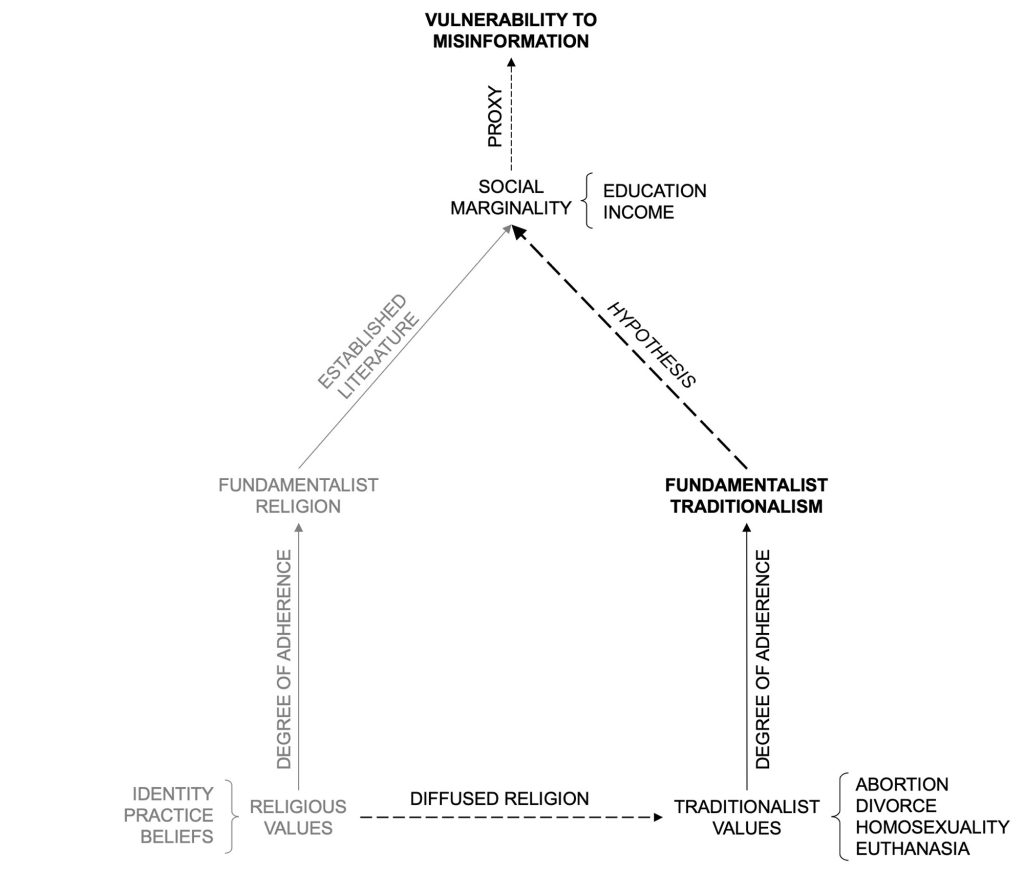
In this paper, I introduce and develop the concept of fundamentalist traditionalism—a rigid, absolutist stance that opposes progressive social values such as LGBT+ rights, euthanasia, and abortion. Using Structural Equation Modeling, I test the hypothesis that this value orientation is associated with a greater vulnerability to misinformation and disinformation.
The analysis draws on representative data from the Italian population, using the European Values Study. I operationalize vulnerability through a proxy of socio-cultural marginality, building on existing literature that shows how disinformation tends to spread more easily among groups experiencing social exclusion—particularly those shaped by rigid, authority-oriented worldviews.
I also draw on sociologist Roberto Cipriani’s concept of diffused religion, which helps explain how religiously rooted values—such as those promoted by anti-gender movements—can circulate broadly in society even in the absence of explicit religiosity. This lens allows me to extend the discussion beyond religious fundamentalism, framing fundamentalist traditionalism as a broader, culturally embedded belief system that can shape susceptibility to misinformation.
Some key findings from the study:
- Religiosity itself is not a clear predictor of vulnerability to disinformation; in some cases, it may even serve as a protective factor.
- Fundamentalist traditionalism, however, emerges as a significant risk factor, even when not directly accompanied by overt religious beliefs.

This suggests the need to account for value-based forms of fundamentalism when designing social, educational, and digital literacy interventions, especially in highly polarized or contested cultural environments. Finally, the study contributes to a more nuanced understanding of the relationship between religion and disinformation. Rather than treating religion as a monolithic variable, we must recognize its diverse expressions—some of which may promote resilience, while others increase susceptibility to manipulation and false narratives.
- The pre-print version (accepted manuscript) is available here: https://osf.io/preprints/socarxiv/9zt3n_v1
- 50 free online copies of the article published in the Journal of Media and Religion are currently available at: https://www.tandfonline.com/eprint/WZP7JXTXXHSIW9G8VAMC/full?target=10.1080/15348423.2025.2541098
Citation: Righetti, N. (2025). Anti-Gender Fundamentalist Traditionalism and Vulnerability to Misinformation. Journal of Media and Religion, 1–15. https://doi.org/10.1080/15348423.2025.2541098