I am pleased to share a new publication, “A Longitudinal Approach to the Analysis of Social Media Engagement: The Case of Anger-Driven Climate-Skeptic Message Propagation During the 2021 German Elections,” published as ZeMKI Working Paper No. 53 (2025) by the Centre for Media, Communication and Information Research (ZeMKI), University of Bremen.
This research project originated within the PolarVis (Visual Persuasion in a Transforming Europe) framework and was further developed during my ZeMKI Visiting Research Fellowship in 2024. Both contexts were crucial in shaping the paper’s focus on the emotional, visual, and algorithmic dynamics of political communication on social media.
Data and empirical context
The empirical analysis focuses on Facebook communication during the 2021 German federal election. The data used in this study were partly collected within my project for the Media Authority of North Rhine-Westphalia (Landesanstalt für Medien NRW) on political advertising and coordinated behavior on social media. This earlier project provided a robust empirical foundation for studying engagement dynamics in election contexts and enabled the longitudinal reconstruction of post-level interaction trajectories.
Contribution and key findings
The paper makes a methodological contribution by systematically comparing longitudinal models with commonly used cross-sectional approaches to the analysis of social media engagement. While cross-sectional designs are widespread due to their simplicity, they fail to capture the inherently temporal nature of engagement processes and are particularly vulnerable to bias arising from timing, unobserved heterogeneity, and algorithmic amplification.
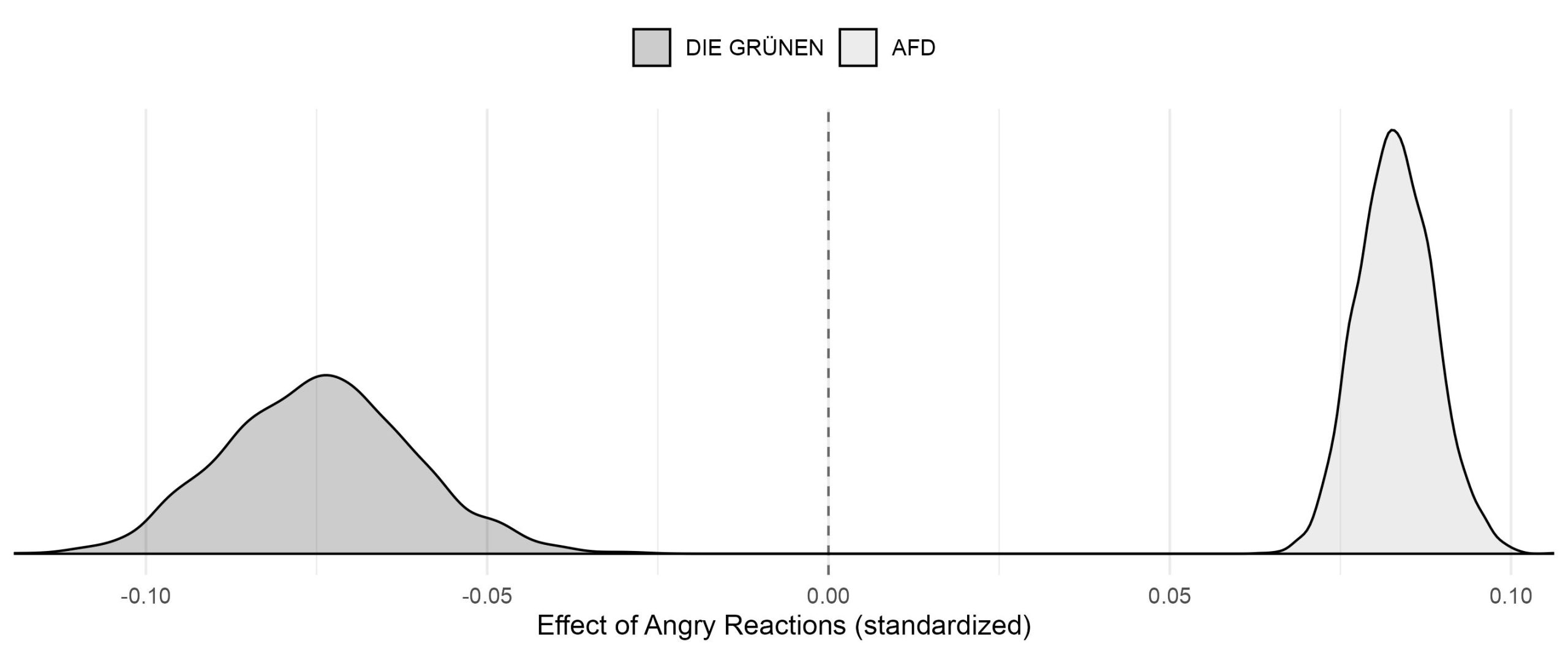
Using longitudinal Bayesian multilevel models, the study shows that anger is positively associated with the sharing of climate-skeptic content from the far-right AfD, while it is negatively associated with the sharing of environmentalist messages from the Green Party. However, a key finding is methodological: cross-sectional models systematically exaggerate effect sizes and amplify differences between parties, whereas longitudinal models yield more conservative, precise, and stable estimates.
Why this matters
These differences are not merely technical. Inflated effect sizes and exaggerated party differences increase the risk of drawing incorrect substantive conclusions, with negative consequences for theory building and reproducibility. Estimates based on fragile cross-sectional snapshots are less likely to generalize across datasets, platforms, or time periods.
The conclusion highlights two related methodological issues. First, longitudinal models help reduce algorithmic confusion by accounting for temporal dependence and cumulative engagement, offering a more credible basis for inference in algorithmically mediated environments. Second, cross-sectional results are highly sensitive to exposure-time assumptions: different sampling strategies and offset choices can produce markedly different estimates, and offsets alone, while helpful, cannot substitute for careful data collection and for modeling engagement trajectories directly.
Overall, the paper emphasizes the value of longitudinal research designs as a pragmatic middle ground between cross-sectional analyses and full time-series approaches. By incorporating temporal dynamics while remaining interpretable and feasible, longitudinal models provide a stronger foundation for cumulative and reproducible research on social media engagement.
This post can only sketch a small part of the analysis. The paper goes into much greater depth on the data, models, robustness checks, and findings, and readers interested in the full story are encouraged to dive into the paper at this link.